
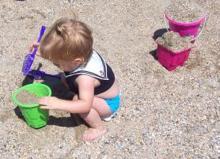
Sand is a granular material composed of fine rock and material particles. Geologists use the term sand grain as a particle ranging in diameter from 0.0625mm to 2 mm; with the next larger size class being termed gravel and the smaller size class is silt. Sand is graded as fine, medium, and coarse.1
Sand most commonly consists of silica (silicon dioxide, or SiO2), but the composition can vary widely depending on the local rock sources and conditions. The spectrum of sand color varies from bright white containing gypsum to black composed of volcanic basalts and obsidian with other compositions producing browns, yellows, pinks, and greens.
Sand and Play
Sand piles are attributed to the origin of the American playground movement for young children. In 1886 piles of sand were put in the yards of the Children’s Mission on Parmeter Street in Boston inspired by the heaps of sand that were placed in the public parks in Berlin, Germany, where children were allowed to play.2
Playing with sand encourages the imagination and creativity of children. Using shovels, buckets, and other containers and toys, children have an endless number of opportunities for exploratory play. Playing with sand includes sensory, cognitive, social, and therapeutic benefits.3
Sand boxes are widely used for child play in both public and private settings. A sandbox is a shallow container or depression filled with sand, which is easily accessible. Sand boxes are inexpensive to build and are also commercially manufactured from plastic. Commercially sold sand boxes often contain covers to prevent animals from contaminating the sand. Adequate drainage is needed under the sand box to avoid stagnate water from collecting after a rain.
Sand boxes in day care settings have minimum state, local and insurance provider requirements to meet for safety issues, including location of the sand box, materials used in construction, drainage, cleaning of sand, and type of sand used.4 Sand tables have been developed for both indoor and outdoor use to make playing with sand accessible for all children.
Sand and Playgrounds
Sand can be used as a surface material under playground equipment for safety purposes. The U.S. Consumer Product Safety Commission (CPSC) has produced Publication No. 325, “Handbook For Public Playground Safety” which suggests the shock absorbency of sand at various depths for placing playground equipment.5 The recommended fall height of sand is 4 feet and is not suitable for use under swings or play equipment higher than 4 feet. Sand can vary widely in coarseness and impact attenuation and should be tested to verify its effectiveness.6
The CPSC publication also outlines installation guidelines, including the method of containment and drainage, and the need for periodic maintenance of leveling, raking, and sifting to maintain appropriate depth and removal of foreign matter.
Advantages for using sand as playground surface material include the low initial cost and ease of installation. Sand is readily available, is nonflammable, and does not break down.
There are disadvantages for using sand as playground surface material. One is that sand does not meet the Americans with Disabilities Act (ADA) requirements because it is not an accessible product. Other disadvantages are rainy weather, high humidity, and freezing temperatures that may reduce the impact attenuation effect of the sand. With normal use, dirt and other foreign materials may combine with the sand, and sand may conceal animal excrement and trash that could cause injury. Wind and children’s play may displace the sand reducing the depth, and sand may be blown into children’s eyes.7
- 1. Hopen, Thomas J. “What Is Sand?” The International Sand Collector’s Society.
- 2. Frost, Joe L. Play and Playscapes. Albany, NY: Delmar Publishers Inc., 1992. p. 113.
- 3. Frost, Joe L., Pei-San Brown, John A. Sutterby, Candra D. Thornton. The Developmental Benefits of Playgrounds. Olney, MD: Association for Childhood Education International, 2004. p. 208.
- 4. King, Tom. “Regulations for Sand in Sandboxes in Day Care Centers,” eHow.com.
- 5. U.S. Consumer Product Safety Commission, Handbook For Public Playground Safety, Publication No. 325. Washington, DC, 1984. p. 5.
- 6. Spease, David. “Sand is Sand; Right?” Safeplay by Design. < www.spease.com/files/Resources-Articles-Sand_is_Sand.pdf > 11 Dec. 2012.
- 7. Op cit., U.S. Consumer Product Safety Commission, p. 38.
