
G
G.I. Joe

G.I. Joe is considered to be the first action figure to enter the toy market. As the first doll-like toy marketed specifically for boys, the first G.I. Joe action figures were just under 12 inches tall and had moveable joints to allow for posing in different stances.
Gaga Ball
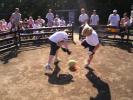
Gaga ball is a popular playground game similar to dodgeball, but it is considered to be a kinder, gentler form of the game. The game is played inside a hexagon or octagon pit.
Games Children Play

Games Children Play: How games and sport help children develop was written by Kim Brooking-Payne and published in 1996 by Hawthorn Press. The aim of the book is not only to outline ways of organizing children’s games, but also to give insight into why the game is appropriate for a particular age or stage of development.
Games for Change

Games for Change is a nonprofit organization that desires "to inspire direct action and real world impact through engaging gameplay." To assist in global humanitarian efforts and educational needs, Games for Change facilitates the creation and distribution of social impact games.
Games for the Playground, Home, School and Gymnasium

Jessie H. Bancroft wrote Games for the Playground, Home, School and Gymnasium in 1909 as a practical guide of 400 games for adult and child players in active games, quiet games, singing games, skilled athletic feats, and ball and bean bag games. He believed that "play, in games and other forms, is nature's own way of developing and training power."
Games With Rules
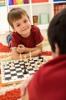
Games with rules is a level of play that imposes rules that must be followed by the players. It requires self-regulation by the children who play, so they can successfully follow the rules and curb their own personal ego needs.
GameTime

GameTime, a division of PlayCore, began operations in 1929 in Michigan. They use research-based design and engineering in manufacturing the company's products. GameTime's independent research studies are conducted by noted experts in the fields of fitness, nature, education, and urban issues, and are used as the foundation when designing their products.
GameTime Athletics

GameTime Athletics provides equipment and supplies for the sports and sport fields of recreational, school, and collegiate programs. Based in Weston, Missouri, they offer both sports facility equipment and supplies and sports field construction and maintenance.
GenMove

GenMove is dedicated to providing programs, staff services, and equipment that assists every child to experience athletic achievements, contribute to a team, and choose a healthy lifestyle regardless of physical limitations, athletic abilities, or past experiences.
Gill, Tim

Through his writing, public speaking, consulting, and independent research, Tim Gill is focused on the "changing nature of childhood, children's play and free time, and their evolving relationships with the people and places around them."
Girl Scouts

The Girl Scouts is a leadership development organization for girls with the mission to build girls of courage, confidence, and character, who make the world a better place. Juliette Gordon Low established the Girl Scouts in 1912.
Glamis Adventure Playground
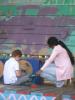
Glamis Adventure Playground is a free supervised playground that provides a wide range of child-centered and child-driven activities. A hand painted sign at the entrance declares the inclusive nature of Glamis Adventure Playground, "There is no war here. We are all fantastic."
Global Toy News

Richard Gottlieb, a known authority on the "business of play," created the blog Global Toy News because he felt there was a need "for serious (and sometimes playful) commentary on the toy industry." His commentary has ranged from exploring controversial issues and trends to discussions of books, games, TV, sports, science, music and interviews of toy industry leaders.
Godbey, Geoffrey

Dr. Geoffrey C. Godbey is a teacher, scholar, speaker, author, and consultant concerning the history and philosophies of leisure, leisure and health, leisure and aging, parks and public recreation, and the future of leisure behavior. He has been "placing leisure into larger and larger contexts, thereby giving leisure larger and larger meaning."
Golinkoff, Roberta Michnick

Dr. Roberta Michnick Golinkoff believes "play is the vehicle through which children maximize their development" and that "children learn best through play and when their learning is embedded in a playful context." As a professor, director, researcher, writer, and speaker, Dr. Golinkoff is "a scientific advocate for children."
Good Sports

Good Sports, a nonprofit organization, was founded in 2003 in Boston, Massachusetts. Their mission is to encourage healthy, active lifestyles in disadvantaged youths, aged 5-18 years old, through the distribution of sports equipment, footwear, and apparel to community sports organizations and health centers.
Goodenough, Elizabeth

As a teacher, researcher, and writer, Dr. Elizabeth Goodenough has explored and championed children’s need for their own spaces. Dr. Goodenough collaborated on a 60-minute PBS documentary “Where Do the Children Play?” that aired in 2007.
Gordon, Gwen

Gwen Gordon is an educational media designer and producer as well as a creative consultant, coach, independent play scholar, teacher, and author. She believes that "playfulness is both the process and the product of evolution," and that "whenever we take the leap into spontaneous free play we catch a glimpse of our unbounded true nature that we share with all creation."
Goric Marketing Group USA
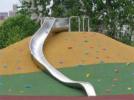
Rick Henke, a creator of integrated playscapes and accessible play equipment for children of all abilities, founded Goric in 1994. Goric's product line includes outdoor play elements that allow children to experience gravity and centrifugal forces, sensory and sound play elements, sand and water play, cable net structures, site furnishings, and protective rubber surfacing.
GP RED

GP RED is a nonprofit organization that works "to identify and fill gaps in knowledge and practical resources" in the health, park, recreation, and land management industries and community "quality of life" agencies.
Gray, Peter

As a research professor of psychology at Boston College for 30 years, Dr. Peter Gray brought the evolutionary viewpoint to general psychology, education, human development, and children’s play.
Greatmats

Greatmats is a specialty flooring company that sells custom floor coverings offering a wide selection of industrial, athletic, commercial, and residential applications.
Green Hearts Institute for Nature in Childhood

Green Hearts Institute for Nature in Childhood was a nonprofit conservation organization focused on “bringing children and nature back together” as a crucial step in raising a new generation of conservation-minded adults.
Grip

Grip is defined as the act of grasping and holding fast. Boys and girls have approximately the same grip strength until the age of 10 years, when boys' grip strength becomes increasingly stronger than girls. Left-handed children tend to have equal strength in both hands, while right-handed children are significantly stronger in their dominant hand.
Grossman, Esther

Esther Fidler Grossman is a playground designer, consultant, and children's safety advocate for indoor and outdoor inclusive play areas. She is passionate about creating child care center inclusive play environments and outdoor classroom learning environments.
Grounds For Play

A division of Superior Recreational Products, Grounds For Play offers dramatic play components, outdoor classrooms, construction play, panels, climbers, slides, swings, music, and fitness elements. They also have site amenities, storage options, shade structures, safety surfacing, and borders.
Gulick, Luther

Luther Halsey Gulick gave significant leadership and promotion to the playground and recreation movements of the early 1900s. With most of his time involved in the fields of physical education and hygiene, he liked to take ideas and thoughts, develop them further, put an organization together to bring the ideas to fruition, and then turn the leadership over to others while he moved on to another set of ideas.
Gun Play

Children have fantasized about triumphing over evil for years. Fighting the "bad guys" seems to be an inherent desire, especially for boys, who use gun play as a means to feel empowered. Whether children are playing cowboys and Indians, cops and robbers, pirates, soldiers, or spies, play guns are usually involved as they engage in pretend play.
