
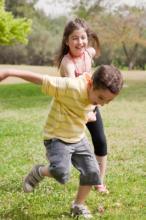
Physical exercise is the performance of some activity in order to develop or maintain physical fitness and overall health.1 For children, exercise is playing and being physically active.
The American Heart Association recommends that children have at least 60 minutes of moderate to vigorous aerobic activity every day.2 Children who get adequate exercise each day are more likely to maintain a healthy weight; build stronger muscles, bones, and joints; lower blood pressure and blood cholesterol levels; and decrease the risk of developing type 2 diabetes. 31 Jan. 2017." href="#footnote3_1o8q8yj">3 Other benefits for children include feeling less stressed, being more alert in school, sleeping better at night, and having an overall better perception about themselves.4
Three elements of exercise can be seen while children play: endurance, when playing tag; strength, when hanging from the monkey bars; and flexibility, when bending down to tie their shoes. Aerobic exercise, which increases the heart rate, develops endurance as children run for continuous periods of time playing games or riding their bicycles. Climbing activities and brachiating on overhead equipment especially build upper body strength. Flexibility is improved in activities that involve stretching, such as doing a cartwheel.5
A primary reason for encouraging children to play actively outdoors is to encourage a lifelong healthy habit of physical activity.6 Because children are becoming more sedentary watching television and playing video games, the percentage of overweight children has more than doubled over the past 30 years.7 It has been found that the number of hours per day children are involved in these sedentary activities can be directly linked to childhood obesity.8 The American Academy of Pediatrics recommends that children 2 years and older be limited to no more than 1-2 hours of quality programming a day on all screen media (television, electronic games, DVD’s, and computer time outside of school). The Society of Health and Physical Educators (SHAPE America) also recommends that school-age children should not be inactive for periods longer than 2 hours at a time. 31 Jan. 2017." href="#footnote9_biyxfan">9
Guidelines for the amount of exercise recommended by SHAPE America include planned physical activity as well as unstructured free play. Toddlers should have a minimum of 30 minutes of planned play and 60 minutes of free play every day. Preschoolers should have 60 minutes each of planned play and free play daily. 31 Jan. 2017." href="#footnote10_fojb6i2">10 School-age children need at least 60 minutes of physical activity a day, which can be broken up into segments of 15 minutes or more, as time allows.11
Since the No Child Left Behind Act was signed into law in 2002, many schools have decreased or eliminated recess to concentrate more on in-class teaching time in an effort to boost children’s test scores. An increased amount of homework also adds to increased sedentary activity at home.12 In addition, less time has been devoted to fitness activity in physical education classes, where children receive instruction on health, motion, and sports games.13
In 1956 when it was reported that America’s children were less fit than European children, the President's Council on Youth Fitness was founded to encourage American children to be healthy and active. This government organization is now known as the President’s Council on Fitness, Sports and Nutrition (PCFSN). Its mission is to engage, educate, and empower all Americans to adopt a healthy lifestyle with regular physical activity and good nutrition.14 A comprehensive school-based program offers educators free access to a health-related assessment for youth fitness, professional development for meaningful implementation, and motivational recognition to empower students to adopt and maintain an active lifestyle.15
With the rising concern of childhood obesity in America, many other organizations have partnered to tackle the problem. NFL Play 60 is a campaign of the National Football League designed to get children active through a four-week program that inspires children to get the recommended 60 minutes of physical activity a day in school and at home.16
- 1. “Physical exercise.” ScienceDaily. < https://www.sciencedaily.com/terms/physical_exercise.htm > 31 Jan. 2017.
- 2. “The AHA’s Recommendations for Physical Activity in Children.” American Heart Association. < http://www.heart.org/HEARTORG/HealthyLiving/HealthyKids/ActivitiesforKids/The-AHAs-Recommendations-for-Physical-Activity-in-Children_UCM_304053_Article.jsp#.WJDJWFMrKUk > 31 Jan. 2017.
- 3. "Kids and Exercise." KidsHealth from Nemours. < http://kidshealth.org/en/parents/exercise.html?WT.ac=ctg#catstaying-fit > 31 Jan. 2017.
- 4. “6 ‘Bests’ About Kids’ Exercise.” NIH MedlinePlus. < http://www.nlm.nih.gov/medlineplus/magazine/issues/winter09/articles/winter09pg6.html > 31 Jan. 2017.
- 5. Op. cit., “Kids and Exercise.”
- 6. Frost, Joe L., Pei-San Brown, John A. Sutterby, Candra D. Thornton, The Developmental Benefits of Playgrounds. (Olney, MD: Association for Childhood Education International, 2004) p. 130.
- 7. Op. cit., “Kids and Exercise.”
- 8. Op. cit., Frost, Joe L., Pei-San Brown, John A. Sutterby, Candra D. Thornton, p. 38.
- 9. "Physical Activity for Children." SHAPE America. < http://www.shapeamerica.org/standards/guidelines/pa-children-5-12.cfm > 31 Jan. 2017.
- 10. "Active Start." SHAPE America. < http://www.shapeamerica.org/standards/guidelines/activestart.cfm > 31 Jan. 2017.
- 11. Op. cit., "Physical Activity for Children."
- 12. Op. cit., Frost, Joe L., Pei-San Brown, John A. Sutterby, Candra D. Thornton, p. 39.
- 13. Op. cit., Frost, Joe L., Pei-San Brown, John A. Sutterby, Candra D. Thornton, p. 44.
- 14. President’s Council on Fitness, Sports and Nutrition. < http://www.fitness.gov/>
- 15. “Presidential Youth Fitness Program.” President’s Council on Fitness, Sports & Nutrition. < https://www.fitness.gov/participate-in-programs/presidential-youth-fitness-program/ > 31 Jan. 2017.
- 16. “NFL Play 60 Challenge.” American Heart Association. < http://www.heart.org/HEARTORG/Educator/FortheClassroom/Play60Challenge/PLAY-60-Challenge_UCM_304278_Article.jsp#.WJDQ1VMrKUk > 31 Jan. 2017.
